Did you know that taking sacred mushrooms intentionally can heal your mind, body, and soul from divorce? Here’s the reason why…
Because of the misconceptions about plant medicines, people often ignore the fact that taking mushrooms can help in healing childhood trauma, anxiety, and depression.
Studies show that selected mushrooms have neurotrophic properties that can be beneficial for the brain and nerve health.
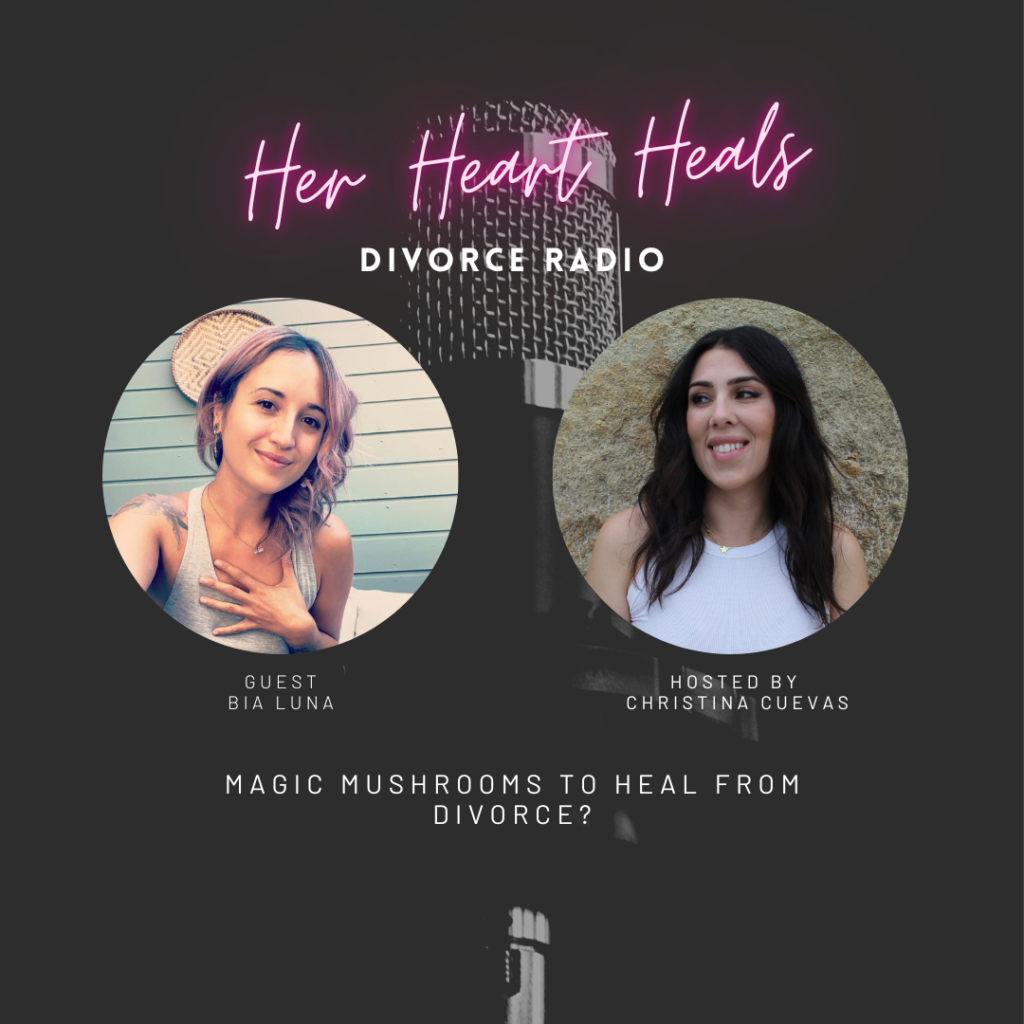
Bia Luna is a pleasure priestess, trauma-informed, intimacy and integration guide supporting women and non-binary sovereigns to reclaim themselves through the path of psychedelics and sensuality. She holds safe ceremony-like sessions for her clients to awaken their truest desires and bring full alignment with their most authentic, alive, sensual, and divine selves.
In today’s episode, Christina and Bia tackle one of the taboo topics about mushrooms as healing medicine for divorce. Bia describes her experience taking these powerful medicines during the most intense period of her divorce journey and how she became more passionate about supporting people using sacred mushrooms.
If you are planning or want to try these magical mushrooms intentionally. You will find helpful tips and guides in this episode!
Full Show Notes – Links, Transcript, & More
In this episode, you’ll hear:
- Bia’s background and how she started working with mushroom
- Sacred mushroom as a powerful ally for divorce
- The layers of stigma in using some healing drug
- How to source the magical mushroom; and
- What is the difference between high dose and micro-dosing ceremonies
Tired of feeling like a failure after divorce?
Sign up for the FREE masterclass waitlist here
Connect with Bia Luna on Instagram
>> @_bia.luna_
Connect with and follow Christina on Instagram
SIGN UP FOR THE NEWSLETTER
Transcription
Christina: I’m so excited that we were able to make it happen and get you on the calendar.
Bia: Me too! It’s my first podcast recording. So I’m excited.
Christina: No way. Oh my gosh. Okay, so you are my first guest in a really long time. So I decided that I was gonna shift the podcast into these mini-episodes. So I’m really excited to have you.
Bia: Oh, awesome. This is great. Yeah. I’m excited to hear about your journey with this as well.
Christina: Yeah. Oh my gosh. Okay. So we have so much to cover, and I know that we know each other. We’re friends on IG, but for those that don’t know about you and your work. Can you tell everyone a little bit about yourself and your background and how you got into this work and this working with this medicine?
Bia: Yeah. So I am an intimacy and integration guide based here in the bay area in Northern California on a Loney territory. I work with women in non-binary sovereigns to return to their own inter divinity and to really shed narratives that are no longer serving them, and heal from a lot of trauma, and I believe that there are really two potent paths that we can take to facilitate this process and that is both sex and psychedelics.
Bia: So those paths to run through my business sometimes overlap, but essentially everything that I do feels like a ceremony. Whether it’s a coaching session where we’re working on intimacy or when I’m helping support others by guiding them and facilitating a high-dose medicine ceremony. So, yeah, and some of those are here in person.
Bia: I also travel to people if that feels called to them, or it’s helping guide others remotely to at least know how to work with these medicines really safely and intentionally. I think that’s what’s got lost along the way and where we’re really headed back to with medicine work. So creating intentional practices and safe practices is also a foundation of my offer.
Christina: Yeah, and so needed, especially when you’re working with people who have gone through traumas. And they’re really trying to utilize this as true medicine and not just this recreational trip, which will get into it a little bit, but yeah, making it just feel so sacred and so special and most of all safe.
Christina: No, that’s awesome. Yeah. So how did you get introduced to this medicine specifically around trauma, and what was it that made you decide that you wanted to bring this work to other people?
Bia: That’s a bit of a layered story. I’ve been utilizing psychedelics in a recreational way for about 15 years now. There were times when I would be at, like, love Fest in San Francisco or, Drop an acid on a river with friends, but I would have these moments that felt like medicine. It felt really sacred, and I would need to pull myself away. So I’ve had those in like unintentional settings, but my first time seeking plant medicine in a very intentional way was a little over a decade ago when I saw it, not Iowasca. I was having at the time really crippling panic attacks about death actually, and I just, I really needed a container for facing my own mortality because the weight of that was getting so strong. I almost wanted it to happen cause I couldn’t bear the thought of it.
Christina: Oh wow! And she,
Bia: Yeah. And sure enough, not that offered exactly what I needed to feel held in that knowing, and thus began my journey working with her. We’ve sat in over a dozen ceremonies, and she continues to peel back the layers of who I am and my purpose, and these lingering traumas. I have ongoing CPTSD. I suffer a lot from anxiety and depression.
Bia: As well as substance abuse throughout my journey and psychedelics, particularly of the plant medicine kind. So SCA and the sacred mushroom have supported me on those. They’ve been absolutely instrumental in healing from a lot of childhood abuse, and yeah, just shedding these layers of what I believed made up the I am and seeing them for just experiences and not who I was.
Bia: So then fast forward, mushrooms. Mushrooms are just interesting. One, I, in the past, had really bad trips, which I now know are just challenging. Cause I was taking them to the wrong place at the wrong time. Yeah. With the wrong support and the wrong resourcing. But a few years ago, Yeah. Mushrooms came into my life again in a very intentional way.
Bia: The same week that I went sober, actually, and I have a deep belief that you should never force working these psychedelics. You’ll feel this whisper, this calling when it’s time, and I felt that call. I felt this whisper that was like, NOW we begin our work, and sure enough, I dove into a really intentional relationship with the sacred mushroom.
Bia: I actually choose a specific strain that I’ve been working with for a couple of years. Cause I think there’s something really profound about building a relationship with these medicines. They’re living, breathing entities with their spirits. So showing them relevance and respect by building that relationship, I think, is really supportive.
Bia: So that’s where, yeah, of course, it’s been a powerful ally, which I went sober about the same time that I got separated and divorced. So it’s very much run tandem with that path, but to thread this all together, where it became my work. I became a life coach in 2020 and was leaning towards women’s empowerment, but I wanted to go a little bit deeper, and I’ve spent many years harnessing and honing ritual medicinal crafts.
Bia: I’m a level two Reiki practitioner. I was a doula for some time, and I really wanted to facilitate transformational processes. And there was a moment when I realized that psychedelic journeys are like a rebirth. It’s like very similar, and it just, I had asked the universe to make my work in alignment with my healing, and that’s when it all clicked.
Bia: So yeah, I just, and that also comes with my experience. I’ve had bad trips. I sat with medicine ceremonies without integration, and I’d come home, and nothing would change. So it became this intentional desire to support others, to get the most from their sessions, to make sure that they have the tools to facilitate the change that these insights from medicine are ushering in.
Bia: So a lot of personal experience that was rambling, but it’s their important threads to how I got here.
Christina: My heart is like just first open for you because it does really seem like all of the layers and everything that you went through on your personal journey and things that you became interested in that maybe perhaps didn’t seem connected at the time.
Christina: How it’s all been brought together to create this sort of magic experience for people when they work with you because it’s unique, it’s uniquely you how you mentioned that you honed in on your ritual and creating that experience for someone else and almost creating how you were saying, like the rebirth, but your work seems to almost cultivating the womb for the rebirth.
Christina: And that’s so special. It’s a lot of people go into certain fields with just this idea of what they want it to be, but your work has truly been an evolution.
Bia: Aw, thank you so much for that reflection. I really love that you mentioned it was like a womb too. I feel like that definitely encapsulates the feeling of holding that I strive to cultivate for my clients.
Bia: I think that we are in this society where we’re so often questioning how we show up and just to give someone space and a container where they can be fully themselves, no judgment in and of itself is really. Medicinal and healing. So I love that reflection you made. Thank you.
Christina: Yeah. So talking about the stigma, because for me, at least, everything that you speak about peaks my interest, and I know that the people who listen to this episode are obviously already with interest peaked around this medicine.
Christina: So I wanted to just talk a little bit about the stigma and how people who have never had access to mushrooms. Or any type of guide. They often think about what they see on media, movies and things like that, or social media, and it’s all, the recreational and it’s your bad trip.
Christina: Everybody thinks that they’re going to go to hell and come back and that it’s that every time is like that. Now I’m with you where I have had bad trips, but for me, it was just the wrong setting. I know consciously what it was that I did to make it go that way.
Christina: So I just wanted to know if you could shed a little bit of light as to what a lot of people go into it, thinking that it is like versus what it can actually be like.
Bia: Yeah. That’s a really great question, also with a lot of layers. I think we all have this lingering residue from the drug war, and this is like the way that psychedelic use was shown in the era of wanting to eradicate its use.
Bia: It’s like the wild, rambunctious, tripped-out hippies that are losing their minds and can’t get their shit together. It’s just that’s this like really broken idea, or you hear about the bad trips where someone like jumps out of a window and I know myself, I grew up in the days of dare.
Bia: The like drugs are bad. Don’t do drugs. Worst case scenario every single time. And we’ve really lost a lot of harm reduction by just making it so black and white. So I think that there are a lot of layers of stigma, particularly the fact that it’s still illicit, and I even experienced some. That’s why the setting is so key.
Bia: Even just being in a public space can bring up these feelings of unsafety. Just due to the nature of what it is that we’re engaging. We all hear those stories, and it’s easy to like really hone in on what went bad for someone.
Bia: Another thing to be said about that is to also reframe well, what is a bad trip? Often time I don’t think there are any bad trips. I think there are challenging trips. I think that they can really bring us into our shadow, and there’s some really deep dark stuff. But I think that sometimes those are the most profound ones. Those are the ones that, in the right container, can bring in the deepest healing.
Bia: And so I think it’s about reframing what a bad trip is in general. But as we’ve mentioned a couple of times in this podcast already, Set and setting, which is a foundation of the pillars of the psychedelic community, just as your mindset going into it and the setting in which you take it. Are you safe? Do you have access to comforts?
Bia: Do you have support if you need it? Things like that are really important to think about as you’re putting this together. So I think with the right. Synergistic qualities of your preparation. There are no bad trips. So that’s speaking to that.
Bia: Mind-blowing.
Bia: Yeah. And
Christina: Never thought of it that way.
Bia: We have these ideas of what it looks like. So based on the drug, we’re based on a dare and everything, but what do I think it’s actually, oh, my gosh. It’s just it’s I think it’s sacred and a heart opening and truth revealing and compassionate and holding and safe and our truth and our right and like connecting to nature.
Bia: I just think it’s such beautiful, wonderful healing medicine, and I’ve I think it’s it’s gonna bring you in the direction. It wants to bring you. I sit with mushrooms recreationally. Now. There are still some times that I’ll take a really appropriate dose at a festival with the proper materials around to make sure I’m safe.
Bia: And I know how to get back to camp if I need. But I remember this one time recently, I was like on the dance floor and I, some trauma came up, and I was like, great, we’re doing this right here on the dance floor. And I cried, and it was a beautiful cry. It was like crying for gratitude, this release, on the dance floor, but it’s so healing.
Bia: I don’t think it discriminates on where that medicine work happens and where a lot of people get lost just like not being in the right place and prepared for that to happen. Yeah. So true. Yeah. That was another really long response, but yeah, it holds. There are a lot of facets to that one about what it like, a lot of understanding of what psychedelics are like is.
Bia: Forgetting everything that we were told it’s
Christina: yeah. Oh, so true. So going, I guess with that when you talk about the Set and the setting and the proper environment to do it in, and in order to cultivate a special experience or set yourself up for success, when you’re going into a guided journey.
Christina: Are there any tips for headspace? A good time of like when to do it when not to do it. I think for me personally, even I always think about my menstrual cycle and wondering if there’s a certain time of the month where maybe it might not be a great idea, or maybe it might be like a heavier trip because I’m super in my fields in like a certain time of the month.
Christina: Also, the proper company to be in or people around. I know you mentioned that when you were taking it. Certain people that you trust and people that kind of can support you as well as how much time to block out and things to have handy.
Christina: Just any type of tips for people who are going to go into a heavy dose guided journey.
Bia: Yeah. To touch on what you mentioned about the cycle, just to speak to that really quickly, being on our moon cycle in the time of a flow is a time of really deep release. And this medicine can also be a time of very deep release, and happening in tandem can be really taxing on the spirit and the body.
Bia: So I wouldn’t personally going through a ceremony while on your cycle. But other guides and other lineages might have different perspectives on that. But that’s my personal perspective that I’ve learned from some of my mentors.
Christina: Totally makes sense.
Bia: And, yeah. And speaking to mindset. Like I said earlier, first of all, don’t ever feel forced. Don’t ever force yourself into a session.
Bia: If it doesn’t feel right. Don’t do it that day. I believe that medicine calls you when it’s time. Patience is key. We always wanna say to be in a positive mindset, but that being said, I’ve gone into very high dose sessions with the intention of stopping depressive episodes, and there are tracks, and it has helped me.
Bia: So sometimes we need this medicine to get ourselves to a positive mindset. So that’s where the setting can be really supportive, of course, working with a trained guide or leader. It can be the best case scenario because they have tools and training. They’ve been maybe carrying the medicine down a lineage, whatever path that might be, to support the really challenging sessions in order to help the clients break through those moments.
Bia: But even so, having a, like a, rather than a guide. A trip sitter is what it’s called. It’s just like a sober friend to hold space for you can be really powerful. I’ll admit I take mushrooms by myself. It’s really powerful to me to have these sessions alone sometimes. And I’ll go get a cabin in the woods completely in solitude. But when you have someone holding space for you that can handle just the logistics of being human, getting you water, writing down anything that you need written down, making sure you don’t bump into walls. I’ve had to do all these things for people. You can go a lot deeper. When you don’t have to handle any of that, or when you just know that someone’s got you and you’re safe, or they can put a living hand on you when you need grounding or give you a hug and hold you through the tears, it’s just having a person that’s sober that you trust or that you’ve hired that can support you really deepens the experience.
Bia: And then yeah, just like you wanna carve out a day. And I always suggest at least carving out the day after because psilocybin and psychedelics really open up your nervous system. And if you drop yourself back into work or social situations or anything the next day too quickly, it can feel really overwhelming.
Bia: And you just want the time and based to process. So the formal journey itself, speaking to psilocybin specifically, is about four to six hours, but you’re in a period of what is called the afterglow for as, as much as up to a few days or more. Just really creating space for whatever needs to unfold, to take place.
Bia: Oftentimes, we’ll have vivid dreams after a ceremony or memories that resurface even in the coming days. So like, how much time does that aside really depends on your capacity? But I say it is a bare minimum of two days, but you’ll anticipate four to six hours being the actual time where you feel like you’re on the medicine.
Bia: Yeah, just making sure you have access to comforts, water, make sure there’s a clear path to the bathroom. Make sure you have blankets. Music is so foundational and can really guide a journey. So preparing a playlist and having a backup plan, it’s important. You don’t wanna listen to like gangster rap or death metal. Maybe you do.
Bia: I don’t know if that is like really grounding to you, then maybe that is your medicine. But I find that really melodic or Boral beats are really beautiful or piano. I know a lot of people really lean towards classical music. Being prepared with music is really key. Lighting is really helpful.
Bia: A journal, things like that, but just mostly making sure you’re in if you’re taking a very high dose session, I suggest being indoors, not somewhere in public, or if you do have to be outdoors or desire to be outdoors, maybe a cabin like in the woods where you can be in solitude, not in a public setting, like a festival.
Christina: It’s too much stimulation and things like that. And I find, too, at least for myself, where it’s, taking this medicine and going on my own journeys. I’ve realized that, like, when I am not in solitude or like in a public setting, or you mentioned even listening to the wrong kind of music.
Christina: Not necessarily the wrong kind of music, but just, I, my point is that we can open ourselves up for, from various stimulations, whether it be music or external sources that can influence our trip. If you will.
Bia: Absolutely. Oh, absolutely. Yeah.
Christina: Okay. And then. Actually, and I’m curious about you, you mentioned that you have a relationship with a specific strain.
Christina: I’m so curious as to what it is, which strain it is.
Bia: Yeah. I work with a strain called a red tie. I have a couple of strains that I really love working with, and most sometimes find their way into my orbit, but that strain specifically over a year ago told me that it was my teacher, and we’ve been building upon this relationship.
Bia: So for 90 plus percent of the times that I sit with the medicine, it’s with that strain, and I don’t always go up. Some of my most potent ceremonies with that medicine didn’t happen on the highest dose. And that’s another thing to recognize, too, like more isn’t always better. Yeah. But it’s, I think, just like I said, they’re living, breathing entities.
Bia: You can only go so deep on a first date, right? Yeah. So building that relationship I found has allowed me to go a lot deeper to understand medicine just as much as it understands me. Mushrooms all have a unique spirit. Maybe if any of these, if anyone listening, sits with cannabis, they might recognize that too, right?
Bia: Each strain has a very different feeling to it. A very different spirit. Mushrooms, much like these plants, are very similar. So getting to know to find the right one for you and yeah. Do you have any thoughts about that?
Christina: Yeah, no, I personally, I’ve never tried that strain before, but no, I was just curious.
Christina: I was like, oh, she mentions specific strain. So it just piqued my interest.
Bia: Yeah. Yeah. And that’s, that actually reminds me of something really important too, is like, When you’re sourcing the medicine where you source it from, you should know what kind of strain this is from the person that you source it from.
Bia: It shouldn’t just be like a random bag of mushrooms. You should know what you’re sitting with. I wouldn’t wanna go that intimate with somebody who I don’t even know their name. Yeah, I would. You should be able to ask this person that you’re sourcing from. Have you sat with this medicine?
Bia: Can you tell me about it? How is it cultivated? What kind of love goes into these mushrooms that I’m sitting with? What kind of relationship is built before they even go in the bag or box or however you or chocolate, however, you might be sourcing it? So really ethical sourcing, really cautious, mindful sourcing.
Bia: Big disclaimer you should never buy mushrooms from somebody that cannot answer those questions at the very least. Have you sat with this yourself? Will you? Would you? Or what strain is this? Can you tell me more about it? If that’s the case, that’s not your medicine. Please find someone who can answer those questions for you.
Christina: Yeah. So important. I’m so glad that you touched on that. Yeah. That’s even very much where you have seen people who are avid gardeners, and they play positive music for their plants that they love so much and just show the difference between plants that are around loving healing and vibrations versus other plants who are just left there.
Christina: There’s like such a difference. I’m thinking of a specific test that was done. I don’t know if it was like with kids or what, but they like had two plants and with one they like played their favorite music, and then they like. Spoke lovingly to the plant, and then the other one talked down to the plant. They were using negative things, and to see the difference between the two was wild.
Christina: So yeah. I’m glad that you mention that.
Bia: Yeah. Yeah. I saw that study. It was really wild, and that speaks to if you wanna take it a step further. Learn how to grow them. There are so many awesome courses on it. Double-blind magazine. They’re amazing. They’ve got a really stellar course on cultivation.
Bia: I know the SF psychedelic society sometimes has courses on cultivation and if you have the appropriate space, do it yourself. If you wanna talk about really deepening your relationship to this medicine, cultivate it. Yeah. And yeah, it’s a cool way to source it and get to know it.
Christina: Now I wanted to ask for, there’s a difference between taking a heavy dose and micro-dosing, and they both are really popular with, micro-dosing kind of being this new term that I’m starting to see a lot of.
Christina: Now, for someone who has. Never tried psilocybin before, and for those of you that don’t know, psilocybin is mushrooms. I use them interchangeably. So for people who have never tried mushrooms, do you recommend a heavy dose for the first time? Can people go straight into micro-dosing? Is there a difference?
Christina: What do you suggest when you get somebody that asks you that?
Bia: Yeah, that’s a great question. I think that they’re both just very different uses of the same medicine. So I think it depends on what a person’s intentions are. Right? So high dose ceremonies, you feel ’em, they’re big, they’re powerful.
Bia: You are processing maybe deep trauma or. Like coming to terms with your relationship to the universe. It’s, there’s really no end to what you can experience, and they’re potent, and they’re powerful. And you oftentimes will spend weeks or months in the integration period after that, where micro-dosing is it’s, some people say sub-perceptual, but I actually like to use the term sub hallucinogenic.
Bia: So micro-dosing is in dosage amounts that are below the hallucinogenic threshold. You oftentimes won’t feel it at all, or you’ll feel things like maybe a heightened sense of empathy or a little bit more joy or openness through the day. Some people get a little bit more energy. Some people feel more creative.
Bia: But you won’t be having that true psychedelic experience, and micro-dosing it’s not the kind of thing you wanna have a one-off. You actually want to work with the medicine and what’s called a protocol for a certain amount of time to UN onboard to your system. And they’re showing that it is really supportive for alleviating symptoms of anxiety, depression, and Certain mood disorders.
Bia: So they’re both very different ways to work with the plants, but I hear so many people think, oh, I took a microdose, yeah, and then they stop. I’m like the thing you really want to work with. For example, I don’t know if any, maybe some listeners have sat with an SSRI, and if you have, you might have understood that it takes about three weeks for an SSRI for depression to be onboarded into your system. Psilocybin also works on the serotonin receptors, and it has about the same onboarding time when you’re working with it from a micro-dosing perspective. So you want to cultivate this relationship.
Bia: You’re not trying to have this like air quote high. You’re really building upon the serotonin receptors and giving them. Giving yourself a neuroplastic state to basically create new neuronal pathways over time. So they’re very different medicines or, sorry, same medicine, very different uses.
Christina: Yeah.
Bia: And that’s where understanding your dosage is too, cuz there’s some people like, oh, I took a microdose at a party. I was like tripping a little bit. I’m like, then that probably wasn’t a true microdose. That was probably a mini dose. Yeah. So again, there’s so much nuance between these dosages.
Bia: You go up a little bit. You’re in a different dose threshold. So even understanding the dose that you take, we spoke. The difference between micro-dosing and sourcing also knowing your dose is key. So if you’re micro-dosing, either sourcing premade capsules, where someone can tell you how much is in there or working with powdered dried material that you weigh very specifically.
Bia: So you know exactly what dose you’re sitting with cause micro-dosing also works best with consistency over time.
Christina: Yeah. And does a person’s weight have anything to do with the amount of dosage, for whatever micro-dosing or just normal doses that have anything to? Does that play into effect? If you will?
Bia: Interestingly, studies are showing that it doesn’t, so a person’s weight does not affect the dosage.
Christina: Wow. Okay.
Bia: Yeah. And people’s tolerances may change at very separate weights. For example, I am a like moderately set woman. I’m just for the sake of this. I’m about 138 pounds, and I have a very high threshold, and I happen to metabolize the medicine very quickly. So I can take quite high doses were someone who I know who maybe.
Bia: A solid, a hundred pounds more than me is fine with a dose far less than the one that I take.
Christina: Yeah. Yeah. Interestingly enough, I can totally relate to that. On different medicine but with cannabis, I was able to consume quite a bit and recently went through some hormonal changes with my thyroid and became hyperthyroid.
Christina: And my body was all over the place, and now I can’t tolerate very much THC at all. It’s actually quite sad, but I definitely have noticed a sensitivity to it. So that’s where I was wondering if it was the same thing with mushrooms because my weight really had nothing to do with it.
Christina: It was just more of how my body reacted to it, so yeah.
Bia: Yeah, totally. I don’t smile. Huh?
Christina: Yeah. This has actually been so helpful. All of this information is awesome, especially for people who are curious and are going through some life-changing moments. I speak specifically about women who are going through a divorce and reemerging on the other side and discovering who they are.
Christina: And at least for me, this medicine has truly been Impactful, whether a normal full dose or even a micro-dose. I’ve used them both ways, and both have helped me get through it. It wasn’t just one specific time. It’s been like a culmination, so I know that this is gonna be incredibly helpful for others as well.
Christina: So thank you so much.
Bia: Yeah. Yeah. I love hearing that it supported your journey through divorce. That resonates so much. It’s been a really powerful tool for helping me also to just soften any resentment that I had or regret or even helping me to see this person who drives me a little crazy sometimes, part of that word, actually.
Bia: I don’t like to use crazy. It drives me up the wall. Yeah. And
Christina: No judgment on that one appropriate.
Bia: And and to see them for their humanness, sometimes as much as I want to feel angry or hurt or resent. When I remove that label of who they were to me at any point, they’re still just a human.
Bia: Yeah. And that’s helped me on my side to just heal a little bit more and in releasing that, that power that they held in their relationship to me. Yeah, as I said, these mushroom teachers came into my life at about the same time that I was going through the most intense aspects of my divorce, and I owe so much of my healing journey to the ways that they held my hand through it.
Christina: Yeah, I think something, and my work is right now directly with women, and in my work with other women, it’s going through a divorce. There’s, it’s such an intense journey because you going through the emotions of when, of dealing with someone who you shared you’re all with right. Your other half.
Christina: These people have seen us in the most intimate and vulnerable ways, and so when you go into something like a divorce, and you’re trying to come out on the other end on your own, you can very easily put around this protective armor this shell. You feel almost incredibly unsafe because of this person who once knew you so intimately. It almost feels like you have to put on this armor to separate yourself from that.
Christina: Even though the person didn’t necessarily have to betray you. I feel like, at least, with my body. My body felt betrayed in a way, and with this work with psychedelics and mushrooms. It really helped me to be vulnerable again, and so I think if I could speak to anything around using this medicine in my divorce journey, it was to make me feel sensual again, vulnerable again.
Christina: I didn’t feel like I had to be ready for war anymore,
Bia: yeah, definitely. That resonates so so much. That sense of betrayal that exists in the body’s psychedelics can really get up in there underneath it, and you said, help cultivate some safety again.
Christina: Yeah, totally.
Christina: Thanks so much for your time BIA. I wanted to end and close with if you could share a little bit about how people can connect with you and if there’s anything that you’re working on right now that people can jump into if they want to work with you. Tell us about it.
Bia: Awesome. Yeah, happy to.
Bia: My website is currently under construction, but it’s gonna be up very soon, and I’m super excited about that. So pretty shortly, people will be able to find me on bialuna.com. So that’s. B as in boy, I a, as in apple, L as in Lucy, U N as in Nancy, a.com. But I am on Instagram. I’m a little dormant at the moment but about to get very active again.
Bia: And that’s @_bia.luna_. So it’s underscore B as in boy, I a, as an apple. L as in Lucy, U N as in Nancy, A underscore, and I am making some big transitions. I just recently left my day job to focus specifically on my business. I’m in the middle of writing my first course, which is so exciting.
Christina: Oh gosh. Yeah, this is amazing.
Bia: I’m super excited about it. I’m gonna have a group offering called inter sanctuary. That is gonna be out probably later this fall, and it is specifically around. Not only helping women and non-binary sovereigns to come home to themselves but to see that home, their inner sanctuary, as sacred.
Bia: So we are like leveling up a little bit on that concept of coming home to yourself and what does it mean to like worship at the feet of your own inner goddess and what’s gonna be really cool about it is I’m going to offer the option to microdose alongside your session. So if anyone wants to micro dose to really up their neuroplasticity, as they’re going through this transformative portal, we’ll do one on one micro-dosing sessions and help them to source the medicine so they can have that ally for supporting them and creating lasting shifts. So that is something I’m like so excited about.
Christina: I’m like, hold on, let me peel my jaw off the floor because that sounds epic. I cannot wait for that. Oh my gosh. Okay. You’ll have to keep me posted when that’s live. Super, super exciting! Yeah. And so needed too.
Bia: I think so, and community is such a. A pillar to this work. Oftentimes these healing journeys that we’re on can feel really isolating, and there’s something so powerful about connecting with others and just knowing that we’re not alone on the path.
Bia: So to weave that very important aspect of the community finally into my work is something very Near and dear to my heart. And, of course, just still working with people one on one in my sacred containers, either on the psychedelic or sexual path. So I’m taking a few more intimate spaces for people over the next few months to wrap up 2020.
Christina: Wow. So much goodness. Oh my gosh. I feel just so blessed to have had this conversation with you. I can’t wait for this podcast episode to come out because, oh my gosh! It’s just so needed, and I think all of the work that you have coming up is so exciting. I’ll be sure to add links to be on Instagram, as well as the website up in the show notes as well.
Christina: Yeah, keep us posted.
Bia: I will. This has been such a pleasure, Christina. Thank you!
Bia: Oh my gosh. Yeah. Thanks, Bia!


Leave a Reply