People drink for many reasons; to celebrate, to relax and socialize, and for others to forget. We often use alcohol as a coping mechanism to deal with stress and trauma, such as divorce or to numb out unwanted feelings.
If there’s one major thing I would advise to anyone doing deep inner work or healing, it’s to ditch their consumption of alcohol during this time… or for good!
People drink for many reasons; to celebrate, to relax and socialize, and for others to forget. We often use alcohol as a coping mechanism to deal with stress and trauma, such as divorce or to numb out unwanted feelings.
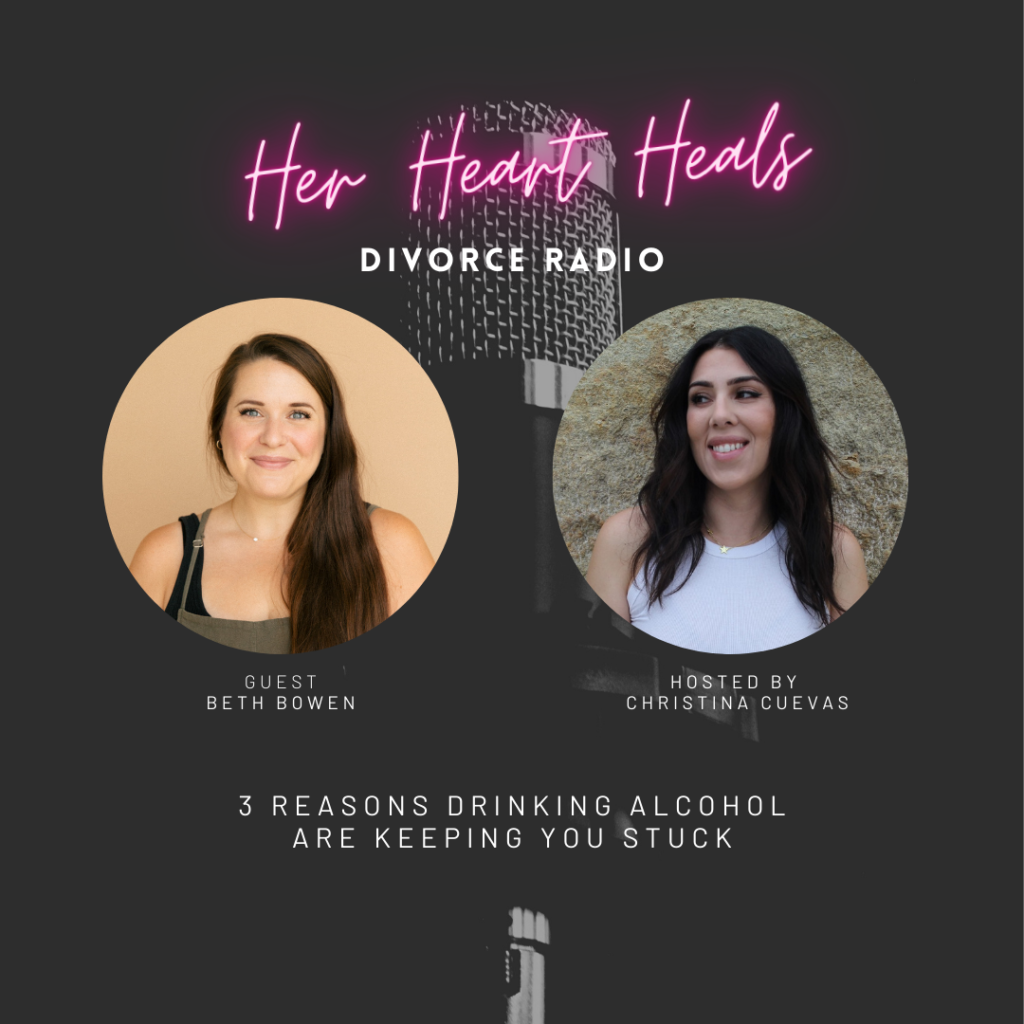
Beth Bowen is a therapist, a sober coach, and the founder of Sober Stories, a multimedia platform dedicated to the power of storytelling in the sober space. She has been sober from alcohol for five years and now helps sober-curious women create an alcohol-free life through her coaching programs.
In today’s episode, Christina and Beth discuss the reasons why drinking alcohol keeps you stuck in our journeys. Beth shares her sobriety journey, the mental and emotional turmoil that alcohol triggers, why drinking is not the answer to your problems, and how to re-discover your authentic self without booze.
In this episode, you’ll hear:
- Why drinking alcohol is a trap
- How to ditch alcohol in your system
- The unexpected gifts and lessons from Beth’s sobriety journey
- How to create a space to self wonder and sober curiosity; and
- The best ways to deal with alcohol withdrawal
Tired of feeling like a failure after divorce?
Sign up for the FREE masterclass waitlist here
Connect with Beth Bowen:
Instagram: https://www.instagram.com/bethbowen_/
Offerings: https://bethbowen.co/work-together
Website: https://bethbowen.co/
Podcast: https://www.instagram.com/wearesoberstories/
1-ON-1 DIVORCE HEALING SESSION
>> https://herheartheals.com/privatesessions
Connect with and follow Christina on Instagram
Transcription
Christina: So I wanted to just kind of dive in as far as your story and your background. I read through your bio that you’ve been sober for four and a half years, but I wanted to know how you got into specifically helping other women do the same, and yeah, what you’re why?
Beth: All right. Yeah, actually, I need to update that bio cause it’s officially five years. September 29th was my five years.
Christina: Oh, so Congrats!
Beth: Thank you. my story is really one of early motherhood and mommy wine culture and being in a state or in a life phase where I was just really isolated and lonely and definitely had undiagnosed postpartum depression, and I ended up using alcohol to cope with it.
Beth: I ended up using wine first. It was the cracked bottle open, poor one glass, have a glass to celebrate the end of the day. Making it through, you know, solo parenting, a baby with a dairy allergy and all of the trivial aspects of that, and one glass turned into two, and then three, and then four, and eventually, it became nightly, and eventually, it was at least a bottle, sometimes two more I was around and I really slowly stumbled into this.
Beth: Like I didn’t, I didn’t do it on purpose. I didn’t, and no one noticed it wasn’t anything that was outwardly reckless or harmful. I never got a DUI. But I really had started to build a physical and definitely emotional, psychological dependence on the nightly bottle of wine, and it really started affecting my mental health.
Beth: I mean, obviously, I kind of came into it with compromised mental health with the postpartum depression that hadn’t been caught, which I think now that I’ve had two kids and have known a lot of moms, like, I think that that’s really common. I think more women fall through the cracks with postpartum depression than are actually served, and what we know about the way alcohol works is that it also impacts mental health.
Beth: So I had this like double whammy of my pre-existing mental health challenges with pouring ethanol on my brain every night, and really was in a place of just complete despair. I had horrible self-talk. I thought I was a trash human.
Beth: I had no self. I had started lying to my husband because one of the things we know about that, too, is that alcohol can compromise your impulse, control, your values, the way you behave and. I just knew I had to stop. I just knew how to stop because my son was two, and I still wasn’t sleeping.
Beth: It just felt like if I didn’t get a handle on it now, I could, I could picture it, I could see myself like ten years from then, and I was like, If I don’t get a handle on it now, I’m gonna be that sloppy mom. Like, have you watched, um, Euphoria?
Christina: Yes.
Beth: Okay. The mom on Euphoria. What’s her name? I don’t remember, but like the two girls, moms, their mom. Yes, It’s coming. I was like, That’s gonna be me. That’s gonna be me. I’m gonna be the sloppy wine mom on the couch like people are gonna start noticing.
Beth: So I knew it was going to go that way eventually. So in 2017, I ended up quitting drinking after many days ones and probably about a year of being sober, curious, and reading books about it. Trying to follow people on Instagram who were sober and just learning more about the mechanisms of alcohol on my physical body and how it actually interacts with our neurochemistry and our mental health, and our nervous system.
Beth: September 29th, 2017, was the last, well, the day that I quit drinking. There’s a little story in the middle of all that. But it was something that felt really lonely at the time. Nobody was really talking sobriety or being sober curious. Sober, curious hadn’t even been coined as a term yet in 2017, so not a lot of people were talking about it unless you went to AA, and that wasn’t a fit for me. It wasn’t an aligned fit.
Beth: So I kind of did it by myself. I kind of did it on my own. It was very lonely. But we’ve. Gone a long way since then. In the way we talk about drinking and the way we talk about sobriety, the millions of different ways people quit drinking and live without alcohol, and so that’s kind of the cliff notes of that.
Christina: What really kind of came out for me as far as, like, what is your story was that? You had this inner knowing. You mentioned this self-talk that you had in the beginning, and I’m curious, like a lot of people really struggle with that because they don’t listen to the voice that’s in your head. You know, the one you’ve got the, like the angel and the devil on one shoulder and the other, and sometimes we don’t always follow that voice, but that voice was obviously strong enough for you to listen to it.
Christina: So, you may not know this, but I guess, if that little voice was saying something to you, what was it saying? Do you recall?
Beth: Yeah. You know, I like that you say inner knowing. I call ’em heart tugs like this pull in the direction. It’s a heart tug. It’s pulling you that way. It’s saying this, not that, and we have gotten really used to distrusting our heart tugs or not listening to them or bypassing them.
Beth: I think this is a whole different conversation, but I think that alcohol separates us from our intuition in general because of the way it disconnects us. It numbs us out. It pushes past our boundaries. So for me, it was a heart tag. It was listening to this heart tag that said, This isn’t working for me.
Beth: At the time, I didn’t identify with the term alcoholic. I still don’t. I just say I’m sober. I’m alcohol-free. But I knew that I didn’t fit in this binary option of this or that alcoholic or somebody who can drink fine. I was in this middle area, which we call gray area drinking now, but I was in this middle space of like this, not this, I, I didn’t quite know what else, but I knew not this.
Beth: With alcohol specifically, it’s what I tell people is, is to listen to the heart tug. It’s really counterculture to be a person who doesn’t drink, and we are very socialized to incorporate alcohol into every part of our lives, and we still live in a world where we view it as a binary, where we view it as you’re a 65-year-old man living under a bridge with a 40 and a brown paper sack or your somebody who can drink quote unquote normally. And so to understand that even if you don’t fit into either one of those, you can still listen to the not this.
Beth: I think at the time it wasn’t ever like a super clear. I was curious about the. I was curious whether or not removing alcohol would fix all of my problems.
Beth: like I had this intuition that it was the one thing that was creating all the other things. But the primary emotion, the primary thought, the primary, like inner knowing I, I experienced at the time was just like, not this, not this, anything but this because it was so pervasive.
Christina: Yeah. I resonate a lot with your story because that was also me, and I think during the times that I wanted to explore that, I had a lot of my friends saying like, But you’re not an alcoholic. You don’t have a problem, just like don’t drink the whole bottle like. Yeah. And I would just kind of go with it because it is very much this or that, so I’ve been sober for over six years.
Beth: Oh, amazing.
Christina: Yeah. Well, alcohol-free, I do say that too. My journey really started when I started to explore generational trauma and when I started to explore generational trauma, I kind of looked back at the way that I was parented and realized that both of my parents really struggled with abusing alcohol, and then I started to go outward from there and say like, it was so a part of my culture. I’m Hispanic and so at the time I went sober, I was going through a divorce and I decided that I wanted to feel my feelings. I did not want to numb out. What happens with me when I drink alcohol is that my ego wakes up.
Christina: And it’s like my ego wakes up, and it takes over, and I start to kind of speak from this place that’s not authentically me. It’s just this scared, broken person that’s hiding behind this ego wall but yeah, that was really kind of my start to exploring that generational trauma, realizing how much alcohol is pushed on my culture and, of course, everybody else is, and then you start to like realize things in like restaurants where like the menu is bigger for the alcohol sometimes than it is for the food and you’re just like, Oh my gosh! And then you kind of just start to see it. But Did you have any unexpected surprises from this journey that you went on?
Beth: Oh my God. Like, where do I start? I feel like removing alcohol was the first time I truly met myself. And if I think back to the history, I mean, I started drinking casually at, I tried to drink once at 18 in high school, and I started drinking casually in college, but in my formative years, in my late teens, my entire twenties, almost entire twenties, I was using a substance that alters my neurochemistry and would create situations where like I would push past discomfort. So if I knew I didn’t wanna go out, or I knew I didn’t wanna do something, I was always pushing myself outside of the boundaries of actually who I am with this substance. And it was also just allowing me to check out and to not have to pay attention.
Beth: You know, I think we talked about mental health earlier. I truly have like realized that my baseline, I have a baseline of depression and generalized anxiety disorder, and that is just the baseline serotonin and dopamine that’s in my brain, and I take medication for that to support that as I advocate the world in sobriety.
Beth: I really started to understand that that was my true baseline, that I was using alcohol all the time to deal, to cope with this mental health when I could just, use support and therapy and all the things to actually treat that and care for that. Oddly enough, today is Tuesday, October 11th.
Beth: So I, I could share this on this podcast, but probably one of the biggest surprises of my entire sobriety is that I came to terms at the age of 30, something that I’m actually bisexual. That I was straight my whole life. There are actually a lot of people who that happens to, but it really has just been this process of self-discovery, of meeting myself for the first time and approaching her curiously instead of trying to fit her into different boxes and to really like push past all of my values and my barriers with a chemical substance.
Christina: Wow. I could not have said it the way that you said that was just like so beautiful and congratulations for just really being able to go into these layers and discover yourself, like you said, like meeting yourself at all of these places, and it’s just such a beautiful journey when you’re able to kind of see that with clarity and owing it all. Although it seems simple to say, but it’s just so complex just when you can really ditch alcohol and see that clarity that comes from it.
Beth: Well, I had a conversation with somebody yesterday, and I asked her; I said, What would you say if I told you that alcohol might be the one thing holding you back from all the other things? Like I think, and as you said, it sounds so simple. It’s just a, it’s just a beverage, it’s just liquid we put in a glass, but the way it en meshes itself in our culture, in our relationships, in our body, it really is completely pervasive. I mean, you’re six, you’re sober, so I know you can understand this, but like, I credit everything I have now to being sober.
Beth: I know for certainty I wouldn’t be here now in the world that I live in if I were still drinking.
Christina: Yeah. Do you feel that it brought you any closer to your relationship with a higher power?
Beth: Yeah, that’s a really interesting question. So part of the reason that I didn’t resonate with the 12 steps is that, at the time, I considered myself an atheist.
Beth: I didn’t resonate with this idea of a higher power. I didn’t, I, it was almost counter to that, it, it was something that I pushed away and that was what I went into sobriety with. And, now I would definitely put more of a question mark on all of that because back to talking about, The inner knowing and the intuition and like serendipity, and there are so many things that I’ve been able to actually notice and to get curious about and to start to wonder and put different pieces together, like really create my own worldview that is not a worldview that somebody else told me to have.
Beth: I would say that I know some iteration of a higher power. I don’t really know how to describe it, yet still a question mark. But I couldn’t have done that without sobriety. I was very like when I was drinking. I was very static. I was very like. I am here.
Beth: This is who I am. I’m gonna sit on this couch corner. I’m gonna drink a bottle of wine every night. And that’s enough. When you take that away, when you take the nightly bottle of wine away, you realize you got a lot more time. You got a lot more time and a lot more space and a lot more mental capacity to really start to say, actually, Let me take a look at all these different parts of my life.
Beth: Let me take a look at, like, what my actual beliefs are and see if those still ring true now that I’m returning to myself. So that’s a very interesting question. Yeah. I don’t know if anyone’s asked me that one before.
Christina: Yeah, sorry, that actually wasn’t planned. I didn’t have that written down how anything like that, but it just came up and, yeah, no, I think for me, And the reason why I ask, I’ve just I come from a family that has a very religious background and I really kind of clung to that faith as I was going through both my journey and sobriety and my divorce simultaneously.
Christina: That was really like the pillar that I hang onto but over time, as I began to have those curiosities and kind of how you were sharing just like these moments of this extra time and the wonder, I love that word so much, um, but just being able to like, go outside and realize that there’s this whole other world happening out in nature where the world will carry on with or without me.
Christina: The world still turns, you know; we still have seasons, and so just kind of like opening up my wonder and awe to like something bigger than myself, so I just wanted to ask.
Beth: Yeah. No, I think it’s, I love the word wonder too, and I think that you know, all of these things that I’ve, I am not, It’s funny, my, my husband and I know this is a podcast to talk divorce and seasons like that. But my husband and I have been married almost ten years, and he says, he’s like, You are so not the person I married, and I’m not at all. We’re fortunate to have grown up together and evolved together, but like I don’t even recognize the person I was seven years ago, eight years ago, and it’s all because I allowed myself this space, to get curious, to have that wonder, to try new things.
Christina: Yeah. , that’s actually you bring up a good point about like not knowing yourself, and that’s a lot of What my clients experience as well when they go through a divorce and sort of that transition and after that healing journey, we can look back and say like, My gosh, I don’t even know who that person was when I was in this marriage.
Christina: So, with that being said, I know we’ve talked a lot about, like, the challenges and the surprises that we’ve faced. But when it comes to working with clients, do you find that a lot of their challenges are like, it’s like it’s pretty similar across the board?
Beth: Yeah, so I realized I forgot to answer your first question about how I got into working with women.
Beth: My background is actually in clinical therapy, and it really was talking about serendipity, just kind of an aligning of the stars, and everything fell into place, and people started asking me for help and showing up in my DMs, and I first started sharing my story on Instagram, and then people kind of started showing up and it just really organically happened because it’s this like beautiful combination of my clinical background, but with my lived experience because I really.
Beth: I don’t think that either side can see it well enough. You can be a clinician, but if you don’t have an addiction background, you don’t have a recovery background yet, you can’t be in it. And if you are in recovery, if you’ve gone through an addiction, you may not have the clinical skills to do this.
Beth: So it really has been like this beautiful conglomeration of my skills and my lived experience. So I’ve been working with women for about two years now, and I work in private and group settings. What I’ve seen and what I like to tell them is there’s nothing new under the sun. Anything that you’re experiencing, anything that you’re feeling, anything that you’re doing, how much you’re drinking, what you’re doing, and behaviors you’re doing while you’re drinking is not a myth.
Beth: There are a million people out there going through the exact same thing. I went through the exact same thing five years ago, and I say that, but there’s nothing new under the sun. Like, I want that to be a balm for people. I want that to be a comfort to know that this is common. This is something that is a textbook. We can see the same roadblocks that people run into. We can see the same triggers, we can see the same origin stories, and what we also know is that people have gone through those and come out the other side.
Beth: So when I tell people this is not new like you can’t surprise me. There’s nothing you could tell me that would shock me, and I want you to know that we’ve seen people go through this before. We’ve seen people go through the experiences you’re having and then come out on the other side, sober, happy, thriving, and to me, that’s really hopeful because if somebody else has done it, maybe I can do it too.
Christina: Yeah. That’s awesome.
Christina: Now, as they’re going through an experience of becoming sober. And you start to have, and I don’t know that this is the right word, so correct me if I’m wrong, but just kind of those withdrawal symptoms or like the feeling, and in those moments now there are some people who have like just this incredible willpower.
Christina: They’re good minds over matter. They can power through it. But for the people who. Really don’t have that support or feel like they have the willpower to make it through that moment. Is there anything that you can recommend for people to lean on during those times?
Beth: Yeah, absolutely. And you’re corrected as withdrawal symptoms.
Beth: Even if we are using alcohol like you could be drinking one glass of wine a night pretty regularly, and you could still have withdrawal symptoms from that one glass. Your body is getting physically adapted to that single glass, so it then begins to expect it, and when we don’t have that, when we don’t input to the substance, we still experience that mini withdrawal on the other side.
Beth: And anytime you have a hangover, all it is is an acute withdrawal. Like your body is detoxing, it’s withdrawing from the alcohol system. So I think withdrawal can be a word that people can be resistant to. And say, Oh, that’s not me. I’m not going through withdrawals.
Beth: You don’t have to have DTs Delirium Tremens to, like, Experience withdrawal. And one of the things that we talk about in this space, and I think it is really important for people to know, is that any habitual alcohol use, any regular alcohol use, may result in what we call PAWS, which stands for post-acute withdrawal syndrome.
Beth: When we experience PAWS, the primary symptoms of that are immense fatigue and anhedonia, which is an inability to feel pleasure. What happens when we quit drinking is that we become dopamine deficient. Dopamine is a neurochemical in our brain. It’s the pleasure chemical the thing that makes us feel good.
Beth: So many people are dopamine deficient when they quit drinking. Your body readjusts after some time, but it feels really bad when you’re first doing it, and I’m glad you brought up willpower because it’s my personal belief that willpower is a myth. I don’t think that. It doesn’t account for our physiology.
Beth: It doesn’t account for the way alcohol actually works with our bodies and the way our bodies are built, and our brains are built to use this substance as they do. I mean, if we take a step back and we think about what alcohol is, it’s a neurotoxin. It’s something that calms our central nervous system.
Beth: It’s also something that gives our brain a lot of those feel-good chemicals. If we think back to like caveman’s brain, like the brain that we were first created with that is only looking out for survival. It wants the things that make it feel good. It wants the things that keep it alive and help it survive.
Beth: physiologically, alcohol makes a lot of sense for us to drink. It is something that really checks all those boxes. Our brain starts to learn that and say, Oh, I’m gonna keep doing that. That felt good. It’s assuring my survival like I’m gonna keep doing that.
Beth: So when we try to stick something like willpower on top of like centuries of neurochemistry, part of the history of addiction alcohol use. The way we treat it in the United States is that pretty much prior to the 1950s, maybe the 1920s, we really understood alcohol as a moral failing. If you were somebody who couldn’t “can’t drink.” We just thought you were a bad person, or you were like possessed, or all those crazy things that they used to say, and then in the fifties, we started treating it medically, and we started to shift away from that language, shift away from kind of this, moral failing language.
Beth: it’s my opinion that willpower is a remnant of that. It is something that is stuck in an old story about how we thought alcohol and addiction, and drugs were intertwined in our society, but really it’s much more chemistry than that. , the next question is, if not willpower, then what?
Beth: For me, A really tangible thing that I want people to use is sober Instagram. There’s a vibrant, sober community on Instagram. It’s really warm, and it’s really welcoming. The sober communities on other social platforms are not my favorite, but sober Instagram is really, really, really beautiful. Start at something like Sober-ish, a thousand hours dry.
Beth: There are a bunch of different accounts that are community accounts that really get you plugged into all of the sober people in the world.
Christina: Sober stories is a good one.
Beth: Oh, yes. Sober Stories is a good one. Thank you. I think one of the things that this is this kind of a twofold thing. This is something that plugs you into a community, and I think community is, I mean, my overall answer is community. That’s the thing that you lean on in those early days. So this plugs you into a community, but it also starts to change the way our brain perceives sobriety because we start to see more people who are opting out, who are choosing not to drink, who don’t drink, living these vibrant, beautiful lives, people that look like us, people’s whose story we can resonate with and see ourselves in.
Beth: that really starts to shift away from this, like, Oh, everybody drinks. I’m the odd man out if I don’t drink that kind of thought pattern. So my first answer is community, and then my second answer is since it’s not willpower, since it’s not willpower because of the way our bodies work, that means we have to really care for our bodies.
Beth: So as much rest as possible, eating nutritious food, that’s gonna fuel you like taking your stress level down as much as you can, saying no to whatever you can. Really caring for your physical body and knowing that those first weeks, months. Depending on usage is gonna be a time of like coming into yourself and returning to yourself and just really taking really good care of yourself.
Christina: Yeah. I love that answer. Oh my gosh. So one of the questions that came up when you were speaking was, your views on sort of this fun drink mocktail? There are a lot of fun, alcohol-free drinks out there. Do you feel that that is part of like contributing to that sort of society to where you’re like, almost like faking it with like the like the glass, Like you’re still trying to like, be a part of the culture?
Christina: How do you feel about that? And do you participate in any fun mocktails?
Beth: Yeah. I think that’s a great question because we’ve seen a complete social revolution in the last five years. Again, I quit drinking in 2017, and the book Sober Curious by Ruby Warrington hadn’t even been published.
Beth: The word didn’t exist, and so when I quit drinking, all you could drink was like Uls, which we all awful. Since then, we’ve really started to see the non-alcoholic beverage industry is bonkers. It is like, get in now all you can, y’all because it is crazy how many new beverages are coming out all the time.
Beth: I get brands all the time that are popping in my inbox saying that they are releasing something new. Those are both drinks that mimic alcoholic drinks, So like NA beers or NA wines, um, NA spirits, but then there are also a lot of non-alcoholic beverages that are intentionally not a dup of an alcoholic beverage.
Beth: My answer to that question is, like, I want you to do whatever serves you. What works for me doesn’t have to work for somebody else, and I see it about 50-50 down the line of people who love having non-alcoholic options and love having a fancy can to hold at a party. Love feeling included love having some, having love having something that’s celebratory and like, to be fair, these drinks are very expensive.
Beth: So you’re still feeling like you’re s splurging, and then there are people who don’t touch it, don’t mess with it because it feels too close to the real thing. It feels like a slippery slope. It feels like it’s inauthentic to them, and so I really, truly just want people to do whatever feels good for them.
Beth: And I caution people in the early days if they’re newly sober if they’re trying this out when they’re trying something like an NA beer. Some of the NA beers taste exactly like an alcoholic beer, and so I caution people in the early days to say like, No, that this may be triggering for you. This may want you actually just to want the real thing instead.
Beth: So be aware of that, but some people also, it helps them quit the real thing because they feel like they have a really good replacement, and it’s really cool to see like the different ways people are doing this. And one of the Instagram accounts I mentioned is run by my friend Kayla Lyons, and it’s called Join Sober ish.
Beth: Soberish is the name of the community, and it’s really starting to celebrate like the different ways that we all do this and that it’s okay that some of us drink NA drinks and some of us don’t. I personally love ’em. I’ve got a full bar cart full of NA beverages and spirits and all sorts of things.
Christina: Okay, cool. I am totally drawing a blank right now, but there’s one, and I have been dying to try it. It’s like a, Is it Kinship?
Beth: Yep. It’s Kin Euphorics, yeah. Their orange can is really good. I can’t remember what it’s called, but yeah, Bella Hadid just came on as an investor, right?
Beth: As, like, a founder of it. She wasn’t the original founder, but she came on as the founder. So it’s funny to see a lot of celebrities jumping on the na beverage industry as.
Christina: Yeah. Yeah. I’m really excited about it. And like you, when the term Sober Curious came out, I was just like, Okay, that’s, that is a really cool label that I can start to use because that was kind of around the same time as my transition to you.
Beth: I’m super passionate about this cause. For me, it’s an access thing. I want there to be more doors open to people to get curious about the relationship with alcohol, and the more labels, store stories, ways of doing this, and options for being sober that we can create, the more that invites other people in, because when it was that binary, when it was, you’re either a person who can drink or you’re an alcoholic under a bridge like that’s not a lot of access points for people.
Beth: So the more we can expand our language, the more we can create more doors for people. I think the better off we all are collectively because we just have a lot more healed people.
Christina: Yeah. Oh my gosh. For sure, I could not agree more. And I think one thing that I wanted to say was that, in my journey, I have found that yes, in, initially it was a little bit difficult to feel that we, I could coexist with my girlfriends going out where I’m like, I’m still fun.
Christina: I can still be fun and not be, you know, under the influence of alcohol. Is that, I mean, do you agree we can totally coexist and. And we’re still fun. We’re just as human as, you know, everybody else. And I love that the community is just growing and that there’s so many more avenues and in, you know, these mocktails and, and all of these other avenues where we can still feel like we’re part of the party cause we deserve to be there too.
Beth: Totally. I mean, I think I have more fun. I am more fun. I’m funnier without alcohol. One of my favorite things to do is go see live music, and I was always drunk. I was always drunk at a concert, and the first sober concert I went to, I like cried because I was so overwhelmed by how much joy I felt. Because also, if you think about numbing out your emotions, you’re numbing out the good stuff too. Without alcohol, it allows me to be my full, authentic self and to really be who I am. Feel all of those feelings completely, feel all the good, feel all the bad, of course. But understanding that, like the connection that I’m having with people that I’m out with, it’s like the connection is deeper.
Beth: I’m feeling things more thoroughly. There’s more space, and it also gives me the ability to really understand what is for me and what isn’t for me. So like, I don’t go to a crowded bar, crowded smokey bar, you’ll never find me there. But I love to go to like a dance club, like love a dance club. So it’s given me the opportunity to really say like, This is what’s fun for me, and this is what feels really good.
Beth: Then I’ll catch y’all on the next one for the, for the things that don’t feel good, and I think with girlfriends too, it’s useful when you can be honest and you can kind of lay out the game plan. I just went on a trip to Mexico with my four best friends, and we live all over the country, so we only get to see each other every four years or something crazy like that, especially after Covid.
Beth: We went to Mexico, and one of my best friends asked me, she was like, Can you just, what are the rules? What helps you? What serves you? And I was like. I’m good like I’m, I’m almost five years sober like I can be around. It doesn’t bother me. But to be able to say to a dear friend or to your girlfriend, say like, I’m totally fine if y’all drink, shots make me uncomfortable, or I don’t really like playing drinking games cause those make me feel triggered.
Beth: Being really clear about what works for you and what doesn’t just kind of clear fear and kind of makes it less of a question mark for everyone you’re spending time with.
Christina: Yeah. Thank you for that. That I think that is, at least when I talk to other women about their curiosity and they’re trying to kind of see what their future would look like and play it out and like almost kind of rehearsing.
Christina: I know I did that. In the beginning, was like, I would rehearse my responses when people ask like, Why aren’t you drinking? What’s going on? You know, So, that was really helpful.
Christina: I really, really appreciate your time, and just to kind of wrap up, is there anything that you’re currently offering, and how can people work with you?
Beth: Yeah. Thank you so much for asking. My signature program, the booze breakup, is created for women who are looking to quit drinking and don’t fit into kind of the traditional AA 12-step boxes.
Beth: It’s a kind of self-paced, community hybrid. So you get the community, and you also get the curriculum. I had almost 60 women go through that program at this point. So that’s really my favorite offering. It’s always available. I do also take one-on-one clients right now. I do believe I have one more opening through the end of the year.
Beth: So the easiest way to find me is really on Instagram @bethbowen_.
Christina: Fabulous. And I will be adding links in the show notes to all of Beth’s offerings, where you can find her on Instagram. Beth, thank you so much.
Beth: Thank you, Christina. This has been so fun.


Leave a Reply