
Divorce can be traumatic for a person. Those suppressed emotions will not heal if you cannot feel them in your body. Somatic healing is taking a body-focused approach to psychology, to the well-being of our mental and emotional health, and starting with the body.
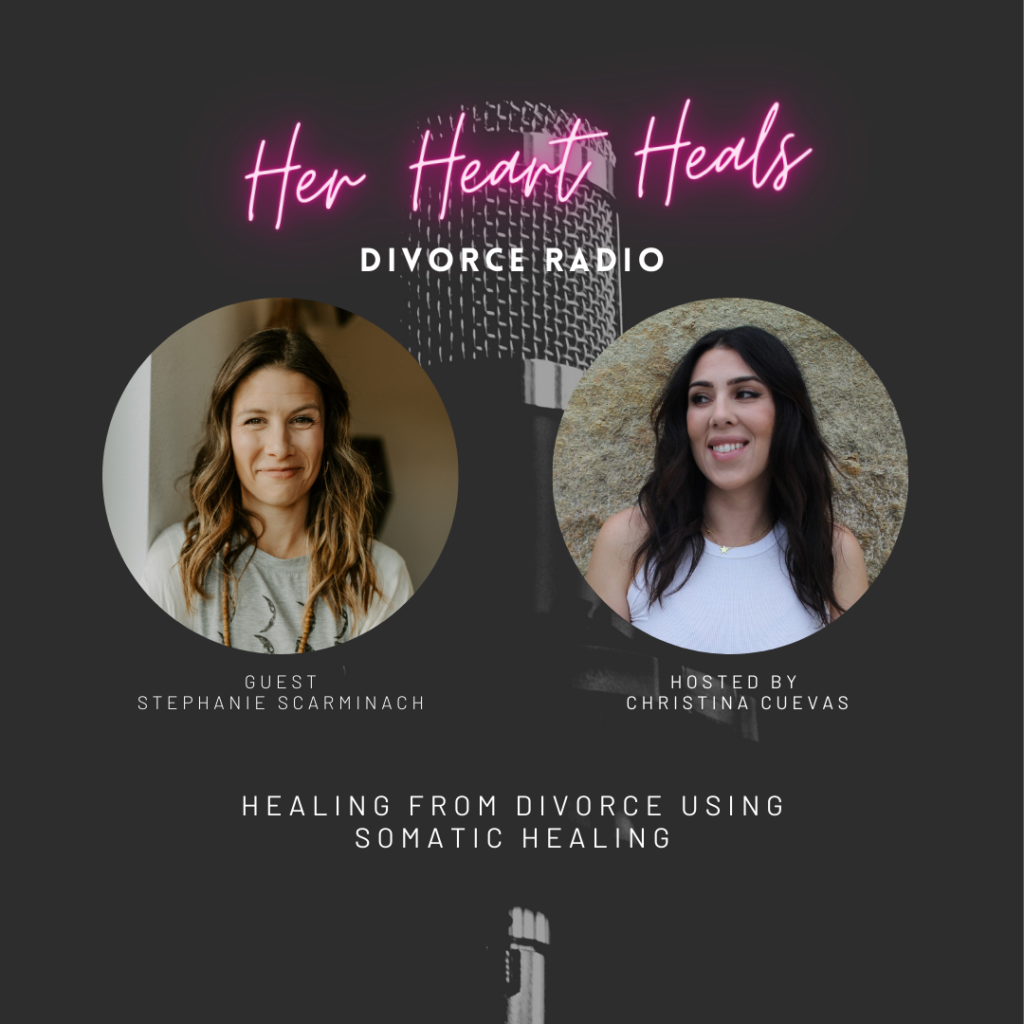
In a world where external pressures and societal conditioning often pull us away from our true selves, somatic healing emerges as a transformative approach to reconnecting with our authentic being. In a captivating conversation between Stephanie, a skilled somatic healer, and therapist, and Christina, a fellow seeker on the path of healing, we explore the profound impact of somatic healing in cultivating authenticity and self-discovery.
Unraveling the Essence of Somatic Healing
Stephanie and Christina dive into the heart of somatic healing, emphasizing its lifelong practice. Stephanie shares her personal journey and highlights the invitation for clients to embrace their own authenticity, showing up for themselves every day. By tuning into our bodies, Stephanie emphasizes, we create a space for clients to lean into the transformative work of somatic healing.
The Catalyst of Divorce
Drawing from her own experience, Christina reveals how her divorce became the catalyst for her healing journey. Through self-reflection, she discovered that her divorce was not solely about her ex or the marriage itself. It was about taking ownership of the patterns and signs she had ignored, unraveling the story that led her to that point. Stephanie resonates deeply with Christina’s metaphorical imagery of the universe throwing pebbles, stones, and eventually a boulder to get our attention.
Somatic Healing and Divorce
In the context of divorce, Stephanie explains the myriad avenues and questions that somatic healing can explore. She emphasizes the importance of understanding how our bodies respond to the situation, the stories imprinted in our nervous systems, and the actions we can take to care for ourselves. By engaging with the sensations and messages from our bodies, we can uncover insights and find ways to manage overwhelming emotions.
The Wisdom of the Gut
Stephanie emphasizes the profound wisdom of our gut instincts, which communicate through nonverbal language. By paying attention to the sensations in our bodies, we can tap into our intuition and decode the messages they hold. Stephanie encourages individuals to get curious and explore what their bodies are trying to convey, ultimately finding support and managing their emotions.
The Power of Pausing and Presence
When triggered or overwhelmed, our logical-thinking brain shuts down, leaving us feeling irrational. Stephanie introduces the power of pausing and meeting ourselves in those triggered states. By regulating ourselves and creating a sense of safety, we can restore our ability to make conscious choices. Stephanie shares practical techniques, such as placing a hand on the chest, engaging in contemplative activities, or simply turning our attention inward.
Connecting with Stephanie
While Stephanie’s one-on-one client calendar is currently full, she has a team of trained facilitators available for support. Additionally, Stephanie has developed a comprehensive 30-day course called “30 Days to Embodiment” that offers experiential activities, guided exercises, and journal prompts. This course provides a solid foundation for individuals to establish their somatic practice and deepen their relationship with themselves.
Embracing Authenticity and Self-Discovery
Somatic healing holds the potential to ground us amidst the chaos of external influences. Stephanie and Christina highlight the importance of simplifying complex experiences, acknowledging that at our core, we seek love, reassurance, affirmation, and validation. By connecting with our bodies and cultivating a sense of presence, we can authentically navigate life’s challenges and embark on a profound journey of self-discovery.
Conclusion
Somatic healing offers a pathway to reconnect with our true selves, nurturing authenticity and self-discovery. Through the wisdom of our bodies, we can unravel patterns, heal emotional wounds, and embrace our innate power. As we embark on this lifelong practice, somatic healing reminds us that our true home resides within ourselves. Let us heed the invitation to listen to our bodies, embrace our authenticity, and embark on a transformative journey of self-discovery through the power of somatic healing.
Keywords: somatic healing, authenticity, self-discovery, body, divorce, triggers, sensations, nervous system, intuition, curiosity, support, managing emotions, pausing, presence, Stephanie, 30 Days to Embodiment, simplifying experiences, love, reassurance, affirmation, validation, grounding, external influences, patterns, emotional wounds, innate power, lifelong practice.
Transcription
Christina: Oh my gosh. I am so grateful that you agreed to come on. I have just been a fan and following you on Instagram. So I was just like, Oh my gosh! I have to pick your brain. I’d love to just bring your work to my audience, so thank you.
Stephanie: Yeah, absolutely. I mean, as soon as you reached out and just shared what your platform is and the kinds of folks that you reached out to, I mean, right away was in alignment for me. That’s so similar to my approach and what I’m wanting to bring to people as well that holistic, full heart and soul healing. So it was, yeah, a no-brainer for me.
Christina: I can’t wait to have a session with you and get started, and really that’s why I, I was following you, but know that this is awesome.
Christina: So for those that have never dove into this work or really are just kind of scratching the surface with dealing with working through trauma, what is somatic healing?
Stephanie: Absolutely. So Somatic Healing is based out of somatic psychology, and this word somatic is, really, the crux of it all. Soma is body in Latin, and so it means that we’re taking a body-focused approach to psychology, to the well-being of our mental health, our emotional health, and really starting with the body.
Stephanie: As we look at all of our symptoms and, ideally, the root causes. So this is really the bridge of the mind and body languaging that’s become so popular. The somatic approach is what gives us body language so that our brains can understand what’s going on. I find that when we start operating from the body first. A lot of what resonates for people is it speaks to their experience. The way they’ve lived, the way they’ve felt, rather than just the cognitive concepts.
Stephanie: Okay, Your child influenced your adulthood, and you learned how to human through these experiences. There’s a different resonance with somatics and somatic healing because we’re speaking to the way that you experienced these concepts. And I think that experiential place is really what becomes the meat that people can sink their teeth into for this practice.
Stephanie: As I facilitate, it really is that blend of body to mind, but we start with the body first and foremost.
Christina: Yeah, I was first introduced. By way of the book, the Body Keeps Score and really kind of starting to notice how chronic illness and diseases were sort of manifested by trauma and things that needed to be released in an emotional form that our body was kind of holding onto.
Christina: So that was my first into the word somatic healing. Now, am I correct in that there’s so many different methods. So there’s breath work, meditation, EFT tapping, things like that, or all of those considered tools around somatic healing?
Stephanie: Yes. So somatic is kind of this big umbrella. Anything that starts with the body is somatically based. So breath work, EFT, and even approaches like internal family systems. Something that’s a little more classically therapeutic, like Hakomi, we can still see the somatic emphasis. In these practices, as long as the approach really integrates the body, how is your body doing with this? How do we meet the body as a tool?
Stephanie: So, something like breathwork? We would absolutely consider that a somatic tool.
Christina: Awesome. And is it kind of everybody’s different to where some things work for some people more than they do for others? Is that an accurate statement?
Stephanie: Yeah, I think I hear the question is almost like, who does this work for?
Stephanie: What kind of person is the ideal client to benefit from somatic approaches from somatic healing? We’ve all got a body. So in a way, all of us could really benefit from this understanding, this deeper sense of how our body is operating and communicating with us. And I find that sometimes there is a stage in our progress, in our development, where we’re ready to dive into that.
Stephanie: Something really common that folks will say when they come into this practice with me, when I start working with somebody is, I don’t want to feel that. That feels too big. That feels scary. I’m actually trying to get away from feeling that, and unfortunately, Somatics is a modality where we are going to ask you to feel it because that is where the feeling is right, is in the body.
Stephanie: If we’re having to feel it, we’re having to tolerate that experience, and so what we’re doing is really diving into the discomfort while using these body tools like Breathwork, EFT, or different intuitive sensing practices that will allow us to be okay at the same time.
Christina: You can feel it. You can heal it. Right?
Stephanie: Absolutely, and that sometimes feeling it is overwhelming; it’s big, it’s scary. It’s intense. And so, how do we help your body really expand its container? Sometimes I use the metaphor with my clients of like one of those little Tupperwares that has little dividers for each part of yours.
Stephanie: And that’s really what we’re gonna do in this practice is help your body figure out, okay, this is where it goes, and this is where the other part sits so that all those things can be present without them overwhelming one another or without one flavor taking over the whole container.
Christina: Yeah, that’s fascinating.
Christina: In doing this, some of these practices for myself. I find as well that it’s, yes, we can lessen the intensity of things. I think people think that it’s almost like an exorcism, and it is just like release from the body. But I have found in my own practice that it’s more about like you’re saying, tolerating or just getting to know what’s happening.
Christina: It’s not necessarily that it makes it easier. I guess it’s the word I that comes to mind for me and is more familiar.
Stephanie: Yeah, absolutely. I think familiar is a great word, and I love this concept of befriending that you’re bringing in. That really is what I’m trying to help all of my clients find, is this sense of relationship to the parts of yourself, to your body.
Stephanie: And we’re looking at the body as a subjective participant in our life rather than an object. It really changes the way that we need to hear what the body is saying. Your body is just the vehicle that takes you through your life. Then it doesn’t matter the way that your body was impacted because it’s an unfeeling, unemotional thing, but if we personify it, say that it’s subjective, it’s been impacted, it does have an opinion.
Stephanie: Well, then we have to establish a relationship to hear that opinion, to have that conversation, to do a little give and take and figure out, Okay, wow, I see this experience impacted you. And in that way, we really step into another layer of reparenting ourselves, I think. Again, brings it to this experiential level, not just the concept of reparenting, but how do you experience that?
Stephanie: How are you stepping into those motions and those practices really by the way that you are treating your body when it is having an experience? How do you show up to engage with it?
Christina: Yeah. Is that also tied to body image?
Stephanie: Oh, absolutely. If we look at the story that we tell when we look at ourselves in the mirror or the way that we respond to our body when there’s something happening.
Stephanie: You know, whether it is breaking out acne or weight, or the shape of your body, the color of your body, all of these different aspects. The way we are responding to those is really the message we’re telling our body. And that can be so challenging to address because. The feeling of like, Ugh, I don’t like this is so real.
Stephanie: And it feels like there’s such good reason for that, right? When we’re really in the midst of that negative self-talk, or the negative image of ourselves at that moment, that frustration, disdain, dislike can feel so real, and that push of like, Ugh, I wish you were different. I wish you could change. Like why can’t you be, you know, whatever it is that we’d.
Christina: I we’re name calling too.
Stephanie: Yes, like really speaking to ourselves in that way. If we’re looking at it from this perspective of your body being impacted, your body can hear you just as a person you’re in a relationship with can hear you. We would never speak to a friend that way.
Stephanie: We would never make those kinds of assumptions or critiques. And if we do, all of it really is an invitation to say, Huh, what’s underneath there? What is prompting this kind of response and engagement in this relationship? Well, I hate this part of my body. Yeah, Tell me about that. Where did you learn that this was something to not like?
Stephanie: What tells you that you don’t like it? What is it about it that is unsatisfactory? But all of those questions, Christina, that’s, I think, the turning point for folks. Right in this work, you know, I’m sure for yourself, I know for me, I went through therapists and like understood cognitively that name calling for myself and this negative self-talk and self-deprecating behaviors weren’t helping, but it didn’t really change just knowing that that was something that I was doing, that was bad for me.
Stephanie: Something changed when I wanted to have that relationship with my body when I realized that I could do something about it. Being with myself around it.
Christina: Yeah, I totally relate. So I have gone through weight loss fluctuations my whole life. Being the chubby girl on the playground with no friends, and then developing an eating disorder in high school to be popular and just finding my comfort in food.
Christina: So then when I would go through a breakup or a difficult time in a relationship. I would go to Food for comfort, and so then my weight would increase again. I just remember in the gym when I would be working out. I like to work out with mirrors in the gym, and I would motivate myself by name-calling myself.
Christina: Hmm. And I would like push myself, like, Come on fatty. I would tell my girlfriends. It motivates me to see my fat jiggle in the mirror. That all changed once I discovered breathwork and other types of modalities for healing and developing that relationship with myself and realizing this body, this vessel has, it’s just me and you, you know?
Christina: It’s just me, myself, and I. We got here and really developing a relationship as though my body was another entity and finding comfort in that. That’s really when I started to look into that relationship of how I was talking to myself, how I was speaking to my body. But yeah, I think the earlier days and looking back at how we treat ourselves, and I even notice it as well with my friends, how they talk about themselves or the other day I heard someone say My stupid bladder. I keep having these issues, and I go. Why do you talk about your bladder like that?
Christina: I’m starting to notice it just more and more about the language that we use when we’re talking to other people and referring to ourselves.
Stephanie: There is this like socially accepted piece to it as well.
Stephanie: Right. That would be something people resonate with calling, you know, Ugh, My stupid thighs. They just won’t change. Like I, it doesn’t matter how many squats I do or how many miles I run. They just stay the shape that there is this normalized piece to it that, for many people, is something they resonate with.
Stephanie: They go, Yeah, I do feel that way. I do talk to my body that way. I do hate this part of myself, and it is so interesting. It goes unnoticed. Right. But I think it is because so much of our western culture doesn’t see the body as a thinking, feeling a thing. It sees it as a vehicle. It’s just a changeable thing.
Stephanie: It’s just a transporter, and if you wanna change it, then just work out harder, eat differently, rather than trusting your body to be the shape that it needs to be, to want the things that are healthy for you. Right. At the end of the day, we are organic matter, and all plants and organic composites are always trying to get back to homeostasis.
Stephanie: I think that’s what our bodies are always trying to do. They’re always trying to get us backed into our safe zone, into our most optimal function. But in order for them to run that way, we have to trust the way they run instead of trying to override them with what our brain thinks the best option is or what our brain thinks is healthy. What if your body got to decide that?
Christina: Just like they say that we’re all born with unique personalities and unique characteristics, we’re all born with unique bodies as well. You know, and it all goes hand in hand with honoring the things that we were given.
Stephanie: Absolutely. And that what works for my body might not work for yours because we are unique in that sense.
Stephanie: Yes, we can use different modalities, and they can resonate with us, but they’ll resonate with us for different reasons. Even something small like allergies, I can’t eat quinoa. That doesn’t mean that quinoa’s bad for some people. That’s the superfood. That’s the thing that their body wants the most, that does, runs the best on.
Stephanie: For me, it just puts my stomach into nuts immediately, and it’s hard to grapple with this idea of not black or white information. There’s no real concrete right and concrete wrong. There’s just a very wide range of gray, and we can see on that spectrum the ways that we treat ourselves well, the ways that we treat ourselves poorly, and all of this in-between space.
Stephanie: Right. There are defining behaviors like the treatment of the people we love. We can very clearly say that we wanna love and respect those people, and that’s one end of the spectrum. And then on the other end, we have folks that need to separate from family, folks that need to place hard boundaries and say, You know what?
Stephanie: I actually can’t have a relationship with. And we would see that on the other end of the spectrum. But that gray area in between is really where we live most of the time. And I think folks have such a hard, hard tolerance for swimming through the gray because it’s not quite as clear. It’s not quite the easy answer.
Stephanie: It takes tuning in, it takes slowing down, and it takes a little bit of work.
Christina: Yeah. My gosh. Okay, I wanted to kind of get back to how did you discover somatic healing work, and can you tell us about the moment when you said, This is my purpose? This is what I have to do.
Stephanie: Yeah, I really came to this work from my own place of need. I was using substances heavily dissociating and really struggling to find and maintain healthy relationships, friendships included. I had been to therapy quite a few times, really off and on almost my whole life. Finally, I found a somatic practitioner, a somatic facilitator.
Stephanie: Really introduced the idea that I wasn’t in my body at all. I was actually living from a dissociated place. I was operating and completing my human functions. I was feeding myself and like was able to hold down a job, but I was finding such lack and such pain and suffering in my, like, day-to-day experiences because there was no relationship with myself.
Stephanie: It was just this constant fight. Why are you the way that you are? I wish you would change. I hate this part of you, or I just really don’t like you at all as a being. And I couldn’t figure out what that was. And I had sat and talked through it so many times. I thought I, and there’s nothing else I can say about it.
Stephanie: And this facilitator introduced the idea of, Well, yeah, maybe you don’t need to say anything else about it. Maybe you need to feel about it a little bit more. It just gets me even when I remember it and talks about it now. But she helped me feel my way through it, and that was really the first time I’d experienced this, like both an idea.
Stephanie: Yes, you can be in pain. You can experience shame, discomfort, agony, and grief, tolerate it, and be okay enough to keep breathing enough not to internally combust and die in this moment. Both things can be true at once, but that’s an adult concept. And so, for so many folks that experience trauma at a young age, this isn’t something that they can do.
Stephanie: So we do have to wait until we have greater capacity and a greater range to be able to do this work. For myself, as I’m doing this work, I was finding these experiences were happening in my life and my work where people would be just dumping their heart out, crying in my arms, and I was coming into my sessions going, I don’t understand what’s happening, like what is going on?
Stephanie: Where people are suddenly like gravitating towards me, like pouring their heart out, like what is happening? This isn’t as familiar. People had always shared with me. My energy had always been connecting in that way with folks very empath from the get-go. But there was something different happening just like the, like total strangers.
Stephanie: I kid you not like crying in my arms at work, and I was moving into, you know, sessions going, What is happening? And she really helped me see, well, because you’ve dropped to this greater place, you’re holding more space for yourself, and other people can feel that other people can feel that there’s a greater container here now.
Stephanie: The more of those experiences I had, the more I realized that that was what I wanted to do. This is where I felt the most purpose and fulfillment was really in holding this great container to help somebody find themselves in the same way that, you know, my facilitator had helped me find mine.
Christina: Oh my gosh. Talk about a calling. Yeah. It sounds like it just truly expanded from the inside out and everybody was just kind of gravitating toward you. Wow. That’s amazing.
Stephanie: And it really, I think, speaks to the intuitive knowing we have, right?
Stephanie: That you can walk into a room and just get a. There’s a sense. Yeah. Or meet somebody new and right away just get like a feeling like they’re a good one or like, Oh, that person, like there was, I don’t know. There’s just something a little off. We do have that intuitive reading for people, and I think that that is such a gift that quickly gets squashed in so many of us because we don’t necessarily have a culture up until more recently where it’s become popular.
Stephanie: To talk about going with your gut trust, your instincts. Know your intuition. . And on top of that, trauma really robs us of our connection to that because often it steals the idea that we know our own moral compass between right and wrong. What feels good and what doesn’t? And so I think there is something in this practice for me about really being authentic.
Stephanie: I’m not here to hold this container for people from the place of. I’ve finished the journey, and I’m at the end. If anything, I actually really practice being transparent, being authentic in my own story. I am still working through my experience because I really do believe that this is a lifelong practice.
Stephanie: This is something that I get to do with my body every day, and I think from that place, there is more invitation for my clients for the following that has showed up to lean into this work with me. You also are an authentic being. You also see this as a lifelong practice. You also wanna show up every day for yourself.
Christina: I feel that for sure. So speaking for myself, because I’m someone that comes from being divorced and going around trauma, and for me, my divorce was really my catalyst to my healing. Everything that came before I said it over and over again. It really wasn’t about my ex or my marriage.
Christina: It really was about all of the things that led me to marry this person and really taking ownership around that and trying to figure out, okay. Did I go wrong? Where could I have seen some of the signs that I have ignored, ignored, and ignored.
Christina: I forgot who’s where I learned this from, but basically that the universe will throw a pebble, and then they’ll throw a stone, and then if you continue to ignore it, they will throw a big giant boulder on top of you, and you just can’t avoid it, and you have to deal with it. That was my divorce for me.
Christina: So specifically around divorce, and for those listening who wanna get involved with somatic healing. How can someone recently divorced benefit from this?
Stephanie: Absolutely. Oh my gosh, Christina and I love that imagery of the pebble, the rock, and then the boulder, and then really the mountainside just sliding down on our heads.
Stephanie: God, I resonate, that is indeed the way that you know the universe, and really, our bodies teach us. It’ll just get louder until we hear it. So the piece about relationships and either recently departing from a relationship, going through the divorce process, or being on that tipping point, there really are like a thousand questions that we can ask a thousand avenues to go down.
Stephanie: But they all really start from how does your body feel about this? What’s happening in your body in this relationship? What are the stories that? That you feel in your nervous system, and from that place, how can you step in to take action to take care of this body, whether it is the experience of shut down or numbing?
Stephanie: Okay. Okay. That’s where we are. I feel numb. That sounds so hard. What would you need to feel? 1% less? Or to feel like you were numb, but you weren’t alone. What would you need to feel supported so that you could figure this experience out? And that’s really where we can step into doing the bodywork and following our gut.
Stephanie: If we look at the nervous system, the lining of your gut has over a million neurons that are the same ones that are in your brain, in your amygdala that we use to think about emotion. Over a million. The exact same, but your stomach doesn’t have a cognitive stream of thought. It doesn’t say, You know, Stephanie, I think this is a good idea.
Stephanie: It just gets butterflies. It doesn’t say, Oh, I think that’s a bad call. It just feels like it, right? There’s these sensations, and from that sensory place is how the body communicates with us. Your stomach is thinking. Your gut instinct is like a real processing rain down. But it’s just using different languages, and so for folks that are either coming out of the divorce experience or on the precipice, I would really, really invite you to start to ask your body, start to get curious.
Stephanie: What are you trying to tell me? What does this sensation mean? What are you trying to get me to hear? And it’s really important that we also get to know the nuances of your system, of your body. Oh, this feeling in my body, it just feels icky. I wanna scratch out of it. It feels like I could throw up if I stay in this emotion for a second longer.
Stephanie: Okay, good. Beautiful intuition. Good knowing, Good tracking from. What do you think that is trying to convey to you? Oh, there’s something about this experience that literally makes me wanna throw up. It makes me sick. Something about this experience makes me feel sick. Oh yeah, this experience makes you feel sick.
Stephanie: And from there, what would help you manage that feeling of sick? What would help your stomach settle a little? Is it leaving for a few breaths? Is it taking extra time? Is it knowing that you’re not alone? Oh gosh. It makes me feel sick because I think it was my fault. Oh, it makes me feel sick because I just realized they’re treating me poorly and getting curious, starting to unpack.
Stephanie: I think of it like a ball of yarn, and you’re just gonna pull on that. Just keep pulling that thread, let it unravel, and when you can let it unravel, I find that your body will actually give you all the answers you need.
Christina: I’m, like, just writing. My whole page is completely filled with notes. That is beautiful, and it truly is really like a ball of yarn. Really where we started with that question and where it ended, it just got so simplified.
Christina: Wow. That’s very powerful.
Stephanie: Simplified feels like a keyword there. I think when folks come into this work, everything feels like the unknown, but when we distill it down, we’re actually pretty, pretty basic beings. We need love, reassurance, affirmation, and validation, but all of those things really come from a sense of presence and togetherness.
Stephanie: I think if we can bring that to our body, that sense of, like, I’m here with you. Everything else just unfolds naturally.
Christina: That’s beautiful. So one of the reasons why I personally love getting support from other people in this work is because a lot of the times when I am in an active triggered state because I too am, you know, recovering every single day, and when I’m in an active triggered state, everything goes.
Christina: It’s like, I’ve done all of this work, and I have hundreds of hours of training, reading all these books, and I’m sure I could find the answer, but at that moment everything goes black, and I know nothing. And so all of these questions are beautiful, but if someone is in an active, triggered state, do you have some type of a quick tip or something that could be easy to remember to help them come back into their body?
Stephanie: Now, what you’re describing is literally your brain shutting down when you’re in a triggered state. We know that if your fight flight is activated, your prefrontal cortex, so the front part of your brain that uses logic and understands long-term consequences, that part shuts down.
Stephanie: So you literally can’t think your way out of it. It’s why so many of us, when we’re triggered, feel irrational. We are our rational, logical-thinking brain is not turned on. That part of the factory is turned off. You’re spot on. That’s exactly what’s happening. So to manage that, to cope with that, what we have to do is meet ourselves in the experience first in that triggered state.
Stephanie: It’s like with little kids, we can’t explain adult concepts to them until they are regulated. Because we need their thinking brain to be online to understand these concepts, we’re exactly the same way. We’re just a bunch of adult-size children. Really.
Christina: Yes, I totally believe that.
Stephanie: Exactly. And so if we’re going to try to get ourselves to see the logic or see this present day as a true reality, we have to meet whatever is also present as the trigger and to do that.
Stephanie: What does your body need to feel validated, to feel affirmed, to feel like it has permission to feel whatever it’s feeling? The way that our brain can see the difference between past and present is very different than the way our body does. Our body sees the present day and is looking for anything familiar to help it understand what’s going on.
Stephanie: It’s all nonverbal, so it’s all the sensory pieces. And so if I am in a conversation with somebody, a stranger, or a friend, and they use phrases like my parents used when I was a kid to scold or shame, my body’s gonna respond to that even if that person isn’t my parent. Even then, if that person isn’t talking about me at all, the familiarity is what your body picks up on.
Stephanie: So we have to be able to pause and notice that. The pause and catch is actually our greatest tool in somatics because what it does then gives you that ability to both notices what’s happening and choose how you’d like to engage and if we’re gonna choose how to respond, we have to be able to regulate ourselves enough to make that cognitive choice right?
Stephanie: By pausing, slowing it down, disengaging either from the moment, Or the trigger itself. You know, it might be that in that conversation with that person, I don’t have time to do that, so it might just be internal. I’m gonna pause for myself. And I know for me, the thing I do the most is put a hand on my chest, just contact my body and let my body know, Oh, I see it.
Stephanie: There’s that trigger. I feel it. I’m with you. And by pausing and then connecting to our body. That’s the first thing we needed as kids. Right we were having an experience that we didn’t understand. It was big, it was scary, it was overwhelming, and we didn’t know what to do with it. We’d never been human before, so we didn’t know what to do with an experience like that.
Stephanie: And if somebody had come towards us, if somebody had been with us and said, Whoa, are you having a feeling right now? We would’ve been like, Yeah, I, I’m having a feeling. I don’t know what to do with it, but something’s happening, and that’s it. Okay. Something is happening. Let me come towards you. Let me be with you, and let’s figure it out together.
Stephanie: That’s what we wanna do with the body. So that pause, and I feel like I’m gonna say that a hundred times today, but the pause, whether that is a deep breath, closing your eyes, putting a hand on the chest, literally turning yourself around.
Stephanie: I know in for work, sometimes after a session in my office chair, roll away from my desk and literally just like let myself spin in my chair just to, ooh.
Stephanie: Just to move, just to break the moment, just to have a pause to be just with me. Nobody else, no other spaces, no other obligations, just you and that feeling. Let’s just be together in that. And so there’s all these little things that we can do, but the really big edge there is about accountability.
Stephanie: When you are having that experience, when you notice that, like, black start to go, the triggers start to fire. We have to choose to pause. Which is so tough; we have to notice that it’s happening and then choose to pause before we can make any sort of executive functioning decision. I think that is where the accountability comes in.
Stephanie: You can have the tools, but we can bring a horse to water, but we can’t have to force it to drink. I think that’s where really the turning point is for most people in this.
Christina: Yeah, I keep going back because I had wrote in big, bold letters and circled it on my paper with you, and that was really the theme of your answer here too.
Christina: And it’s so powerful. And I even feel my own emotions rising. I’m not even in an active triggered state, but just when you describe the hand on the chest, I think even having some type of automatic response that I know that I do. When you all say like, Oh, I always do that thing, maybe we can all just have a thing that we do before our brain gets there.
Christina: Right. Or like our body can respond first, and we can say, Okay, I’m gonna put the hand on my chest. I love, I love that, and like I said, having that state with you. I’m with you, and I’m here. That is very powerful.
Stephanie: You know, hand on the chest is I’m meeting the body, right? I’m not trying to get rid of it. I’m not trying to make it go away. I’m just letting it know I’m here. And we can do that in a variety of ways. You know, some people are, Runners. Some people are yogis. Some people are, you know, contemplative dishwashers, myself included for that one. Doesn’t matter what the thing is as long as you are engaging your body from this contemplative, connective place.
Stephanie: That can be, again, doing dishes, sitting on the floor, going for a run, taking ten deep breaths, whatever the thing is. The underlying theme is I’m with my body. I’m connecting to my body.
Christina: Very important. So for those who are now like just at the edge of their seat and saying, How can I get in touch with Stephanie?
Christina: I need to work with her immediately. Do you have space? Are you taking on one-on-one clients right now?
Stephanie: So I do work with individual clients. Right now, my calendar is full, but I do have a couple of folks that work with me, other facilitators that somatically trained and trained to facilitate in the style that I approach folks from.
Stephanie: There’s also a 30-day course that I really, really just poured my heart and soul into that is a really good beginning step for folks who are just hearing about somatics or just being introduced to this idea that your body has an opinion. It’s called 30 Days to Embodiment and gives you a ton of experiential activities.
Stephanie: Via video where I will actually walk through the exercise with you, giving you journal prompts and prompting questions to help you dive in deeper, to establish that relationship so that you can really create your own practice, your own relationship to yourself. And for folks who are, you know, wanting to do a little more deep dive work.
Stephanie: Again, I’ve got some folks on my team who have availability right now for us to be able to take more folks.
Christina: Awesome. I will be sure to link your Instagram and your website. I’ll also be sure to grab the link for your 30-day course as well. For those of you that are interested, you can find her at Stephanie Somatics on Instagram.
Christina: I highly recommend everybody go follow her because just there is so much wisdom that comes through there, and it’s so helpful. So thank you for sharing this information with everybody. It’s so needed. Like I said, for me, for myself. I get so much out of it. So thank you.
[00:37:19] Stephanie: Absolutely. It’s such an honor to get to share this work.
Stephanie: When I started the social media account a couple of years ago, I had made it just to be able to talk about this, that this was a modality, this is out there, and I was in the process of looking for jobs after graduating from school and was having to explain to clinicians in the field. Somatic therapy is a thing.
Stephanie: This is a way that we can address trauma. This is why a way we can understand a client’s experience better. And that blew my mind that people didn’t know again. So I am always just so, so moved by how many people this work resonates with because I want everyone to know this is a thing.
Christina: Yeah. I mean, it truly is.
Christina: And I’m sure you can relate too, but it’s like even from interacting out in my community, and you see so many things on whether it’s on TV and things that people are listening to and content that other people are absorbing and society conditioning and things like that, and somatic healing, I believe truly is going to be the way that we stay grounded, and we stay connected and that we realize the things that are most important because there are so many things out there that make it seem like we have to be someone else, follow this other thing, and we lose sight of where our home is.
Stephanie: Yes. Agreed. Yeah, and what a beautiful, beautiful remembering process to find that your home is actually within yourself.



Leave a Reply